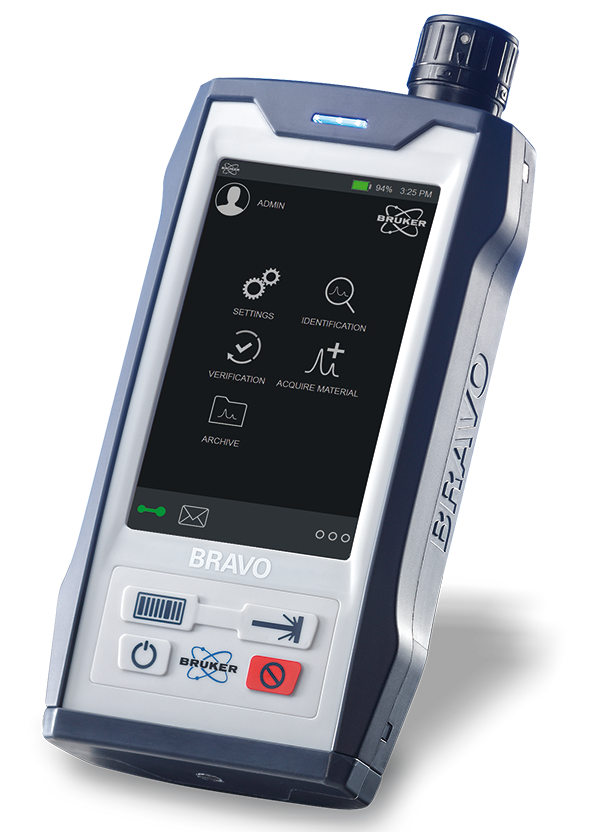
Bruker BRAVO

Category:
ADVANTAGES
APPLICATIONS
TECHNICAL SPECIFICATIONS
VIDEO
Advantages
- SSE™ technology for effective fluorescence mitigation
- DuoLaser™ excitation at 785 nm and 852 nm for a broad spectral range
- Class 1 laser for safe and flexible operation without special laser safety requirements
- Intuitive OPUS TOUCH graphical user interface
- Automated measurement tip recognition with IntelliTip™
- Verification and identification workflows
- Extensive libraries with more than 20,000 reference Raman spectra
- Custom spectral libraries can be created from user measurements
- Wi-Fi and Ethernet connectivity
- Remote operation via OPUS
- SyncService for automated data transfer
- Support for 21 CFR Part 11, Data Integrity, USP, and Ph. Eur. requirements
Applications
BRAVO is suitable for a wide range of industrial, laboratory, and research applications, including:
- Pharmaceutical industry – raw material identification and quality control
- Incoming goods inspection
- Identification of unknown substances
- Identification of narcotics and other dangerous substances
- Polymers and plastics – material identification, quality control, and recycling
- Analysis of pigments, minerals, and gemstones
- Art and restoration – non-destructive material identification
- Laboratory research and development
- Material analysis through foils, bags, and glass bottles
- Contactless analysis of sensitive materials
Technical Specifications
- Technology: Raman spectroscopy
- Type: Handheld Raman spectrometer
- Laser excitation: DuoLaser™ – 785 nm and 852 nm
- Spectral range: Broad Raman spectral range, with optional extension down to 170 cm⁻¹
- Fluorescence mitigation: SSE™
- Laser classification: Class 1
- User interface: OPUS TOUCH
- Connectivity: Wi-Fi and Ethernet
- Software: OPUS
- Reference libraries: More than 20,000 Raman spectra
- Measurement accessories: Bag Tip, Vial Tip, Tablet Tip, Sample Cup Tip, Variable Focus Tip, and others
- Remote operation: Via OPUS software
- Data transfer: SyncService
- Compliance: 21 CFR Part 11, Data Integrity, USP, and Ph. Eur.
