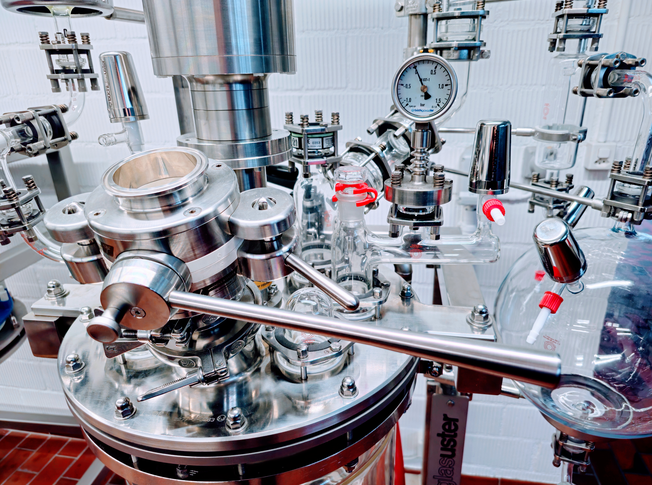
HPAPI Reactor & Process Systems

Büchiglas HPAPI Reactor & Process Systems are designed for the safe handling and processing of highly potent active pharmaceutical ingredients (HPAPI), from laboratory and pilot scale to production scale. The systems are engineered to provide maximum operator protection, reliable operation, and compliance with the strict requirements of the pharmaceutical industry.
ADVANTAGES
APPLICATIONS
TECHNICAL SPECIFICATIONS
High Containment Nutsche Filter
Advantages
- Fully customized according to specific process requirements
- Maximum operator protection through reliable containment systems
- High level of leak tightness and easy cleaning
- Integration with isolators and containment systems
- High chemical resistance thanks to materials such as borosilicate glass 3.3, glass-lined steel, fluoropolymers, and Hastelloy®
- Flexible buchiflex glass piping system
- Suitable for cGMP processes
- Compliance with ATEX and PED requirements
- Complete validation documentation, including IQ/OQ protocols and QPP
Applications
- HPAPI production
- Synthesis of cytostatic and cytotoxic molecules
- Production of antibody-drug conjugates (ADCs)
- Synthesis of toxic payloads for ADCs
- Development and synthesis of linker-payload components
- Production of hormones and hormone-based substances
- Laboratory synthesis of highly potent pharmaceutical compounds
Technical Specifications
- Reactor volume: 5–250 L
- Operating pressure: −1.0 to +0.5 bar
- Temperature range: −90 °C to +200 °C
- Materials: borosilicate glass 3.3, glass-lined steel, Hastelloy®, PTFE, PFA, and PEEK
- Protection: ATEX compliant
- Cleaning: CIP (Clean-in-Place)
- Design: customized for laboratory, pilot-scale, and production processes
High Containment Nutsche Filter
The HPAPI solutions also include the High Containment Nutsche Filter for fully enclosed filtration of highly potent API substances. It enables safe solid-liquid separation with minimal operator exposure. The filtration vessel has a capacity of up to 30 L, with an operating range of −1.0 to +0.5 bar and a temperature range of −60 °C to +200 °C.